Blast Engineering
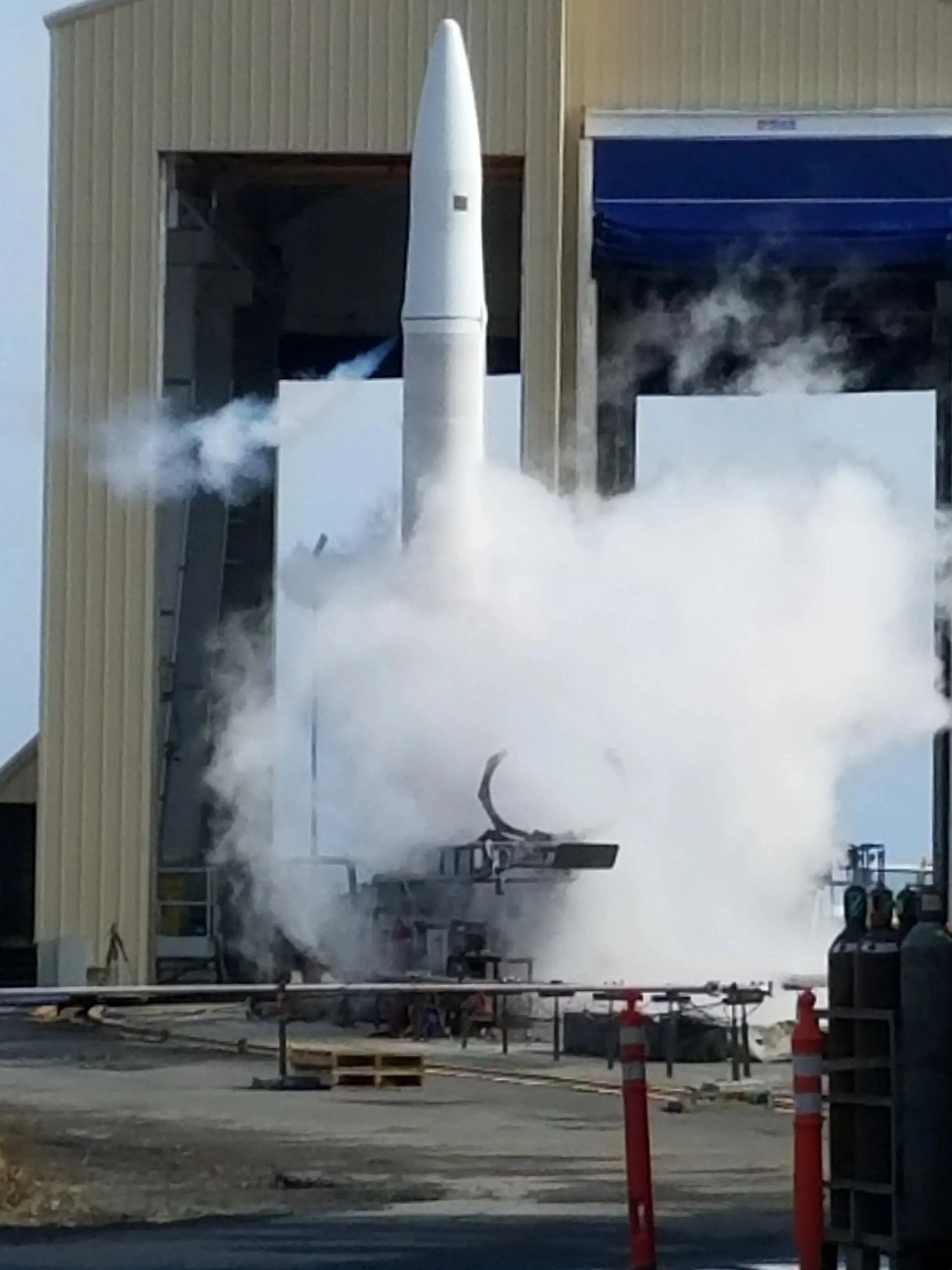
Flanagan Engineering provides blast-resistant structural design for government, industrial, and critical infrastructure facilities. We design to ASCE 59 and UFC 3-340-02, using computational fluid dynamics (CFD) to capture the reflections, confinement, and venting that simplified methods miss. The result is defensible blast loads, efficient structures, and designs that hold up under review. Our principal brings direct experience designing hardened defense and aerospace facilities, from test stands to protected control buildings.
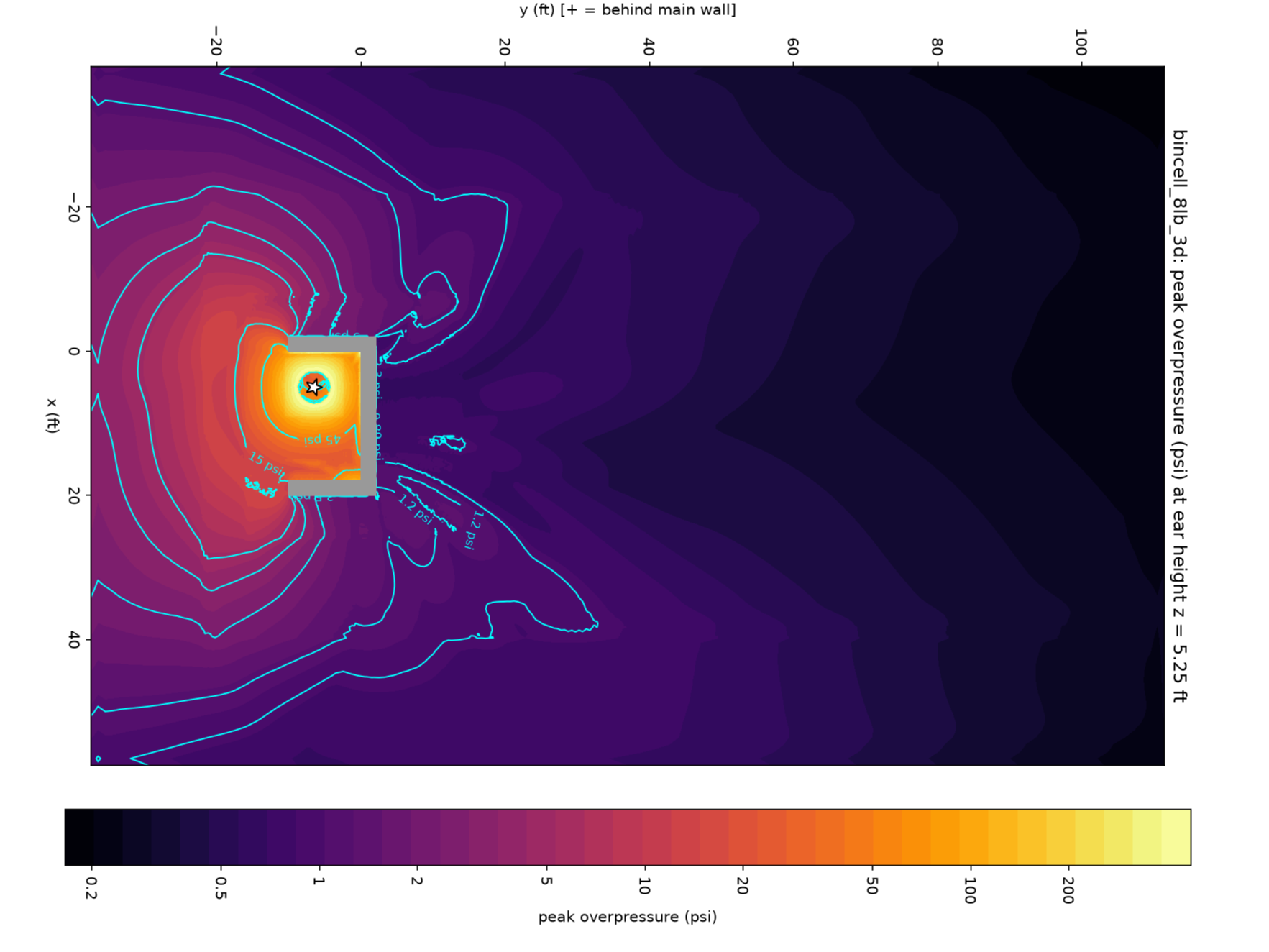
CFD pressure field for an 8 lb TNT-equivalent detonation in a three-sided cell. The model captures reflections off the back and side walls and the resulting pressure concentration at the interior corners, effects that simplified methods don't resolve.
Blast Load Definition & CFD Modeling
Accurate blast design starts with accurate loads. Traditional methods from UFC 3-340-02 work well for simple, open geometry, but real facilities rarely cooperate. Walls, roofs, barricades, and adjacent structures reflect and focus shock waves, confined spaces build up gas pressure, and openings change how that pressure vents. Chart-based methods often under-predict these effects, or cover the uncertainty with conservatism that drives up structural cost.
We use computational fluid dynamics (CFD) to model blast wave propagation through the actual facility geometry. This resolves multiple reflections, pressure enhancement at corners and re-entrant surfaces, shock channeling between structures, and venting through open faces. The output is a pressure and impulse history for each surface you care about, whether a wall panel, door, roof, or neighboring building. Those loads feed directly into structural response analysis, so the design is based on how the building will actually be loaded rather than a worst-case envelope.
Every CFD model is checked against UFC 3-340-02 predictions and hand calculations, so the results hold up under review by your safety office or approving authority.
Typical applications: partially confined cells and bays, barricaded operations, test stand and processing building layouts, internal explosions with venting, and evaluating whether an existing structure can take a new operation or a higher net explosive weight
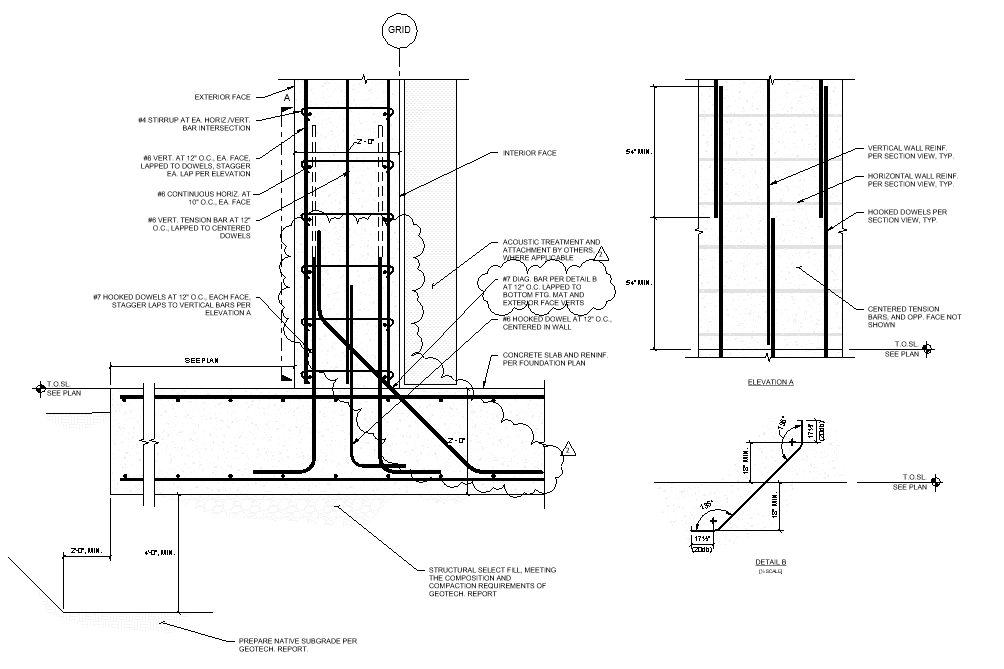
Blast-resistant concrete relies on detailing as much as strength: equal reinforcement on both faces, closely spaced stirrups, and diagonal bars at the joints let the structure absorb extreme loads without losing integrity.
Blast Resistant Structural Design
Accurate loads only matter if the structure can take them. We carry CFD-derived blast loads through dynamic analysis, from single-degree-of-freedom (SDOF) checks to explicit finite element models, and design each member to ASCE 59 and UFC 3-340-02 response limits. We detail reinforced concrete and steel for ductility and constructability, including blast doors, penetrations, and connections, so the building performs as designed.